Two Quotes, Same House, Half the Price. What's Missing?
Why one painting quote comes in at half another for the same rooms — and the specific work that quietly got removed to make that number possible.
A homeowner in Venice sent us three quotes last season and asked a fair question: how can the same eleven rooms be one number from us and less than half that from someone else?
They were both honest quotes. That is the uncomfortable part. Neither company was lying. They were simply describing two different pieces of work using the same eleven room names, and nothing on either page made that visible.
Here is what actually sits inside the gap.
Paint is the cheap part
Start here, because it reframes everything else.
On a normal interior job, the coating is a small fraction of the total. Almost everything you are paying for is time — hands on surfaces, in your house, before any colour goes on.
Which means a quote cannot really come down by buying cheaper paint. There is not enough money in the material to make a meaningful dent. To halve a number, you have to halve the hours. And the hours that get removed are always the same ones, because they are the hours nobody can see on the last day.
The five things that come out first
Every low number on the Gulf Coast is built by removing some combination of these. None of them will be listed as removed, because they were never listed as included.
The second caulk pass
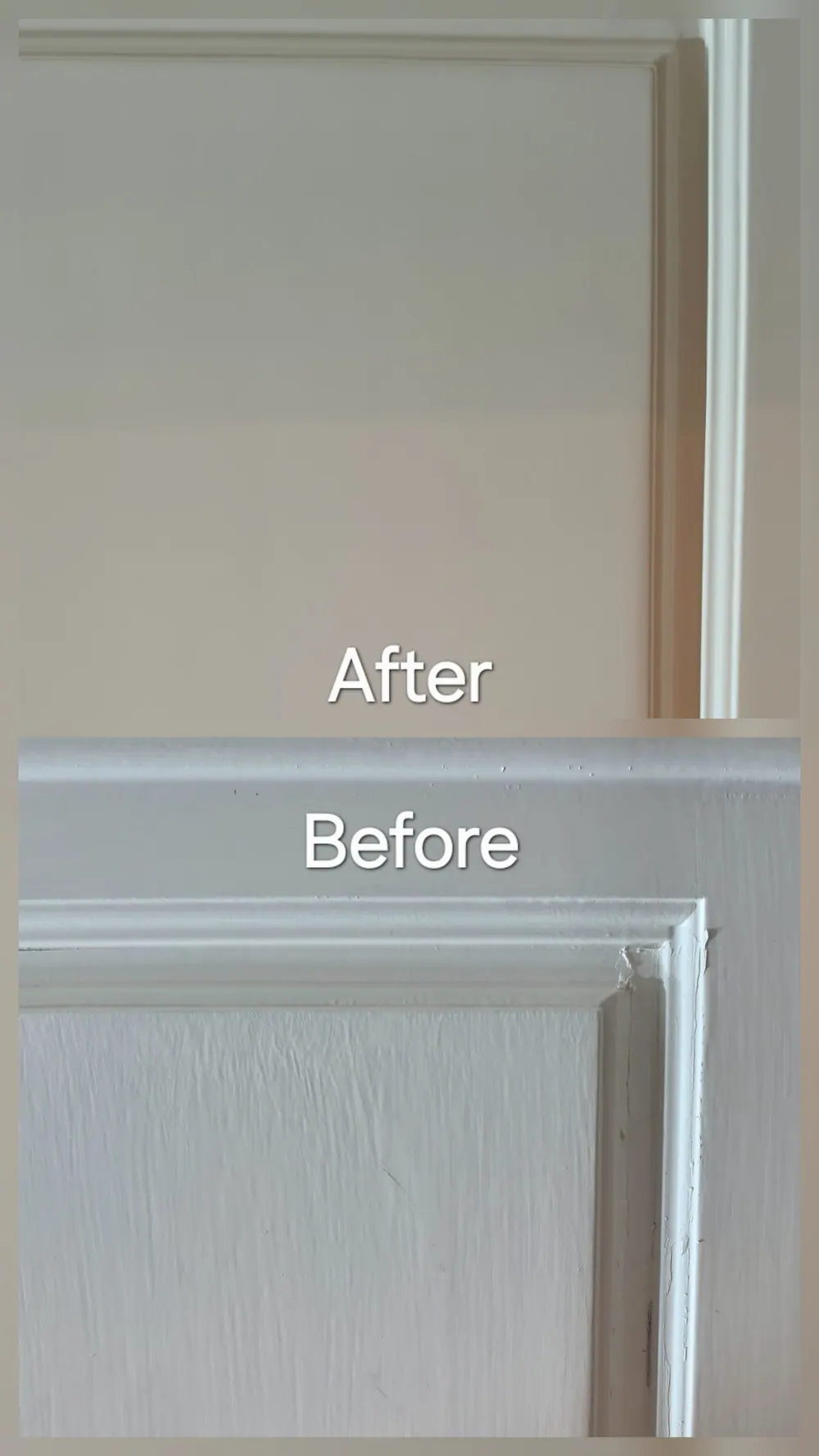
Caulk shrinks as it cures. Everyone’s does. On a trim package it pulls back at the mitres and at the wall line, and the only fix is to come back after it has moved and run it again.
That is half a day on a whole house, zero material cost, and completely invisible at handover. It is also why some trim still reads as one piece three years on while other trim shows a hairline crack at every corner by the second Season.
Sanding between coats
On trim and doors, the difference between a surface that feels manufactured and one that feels like wood with paint on it is a sanding pass between coats. Pure labour. No material. Nothing in a photograph will ever show you whether it happened.
Taking the doors off
A door has six faces. Four of them you look at, two of them you do not — the top edge and the bottom. A crew that removes doors, sprays all six and rehangs them is spending real hours on hardware, labelling and reinstallation.
A crew that leaves them hanging saves all of that. In a humid house on a barrier island, the top edge of a door is exactly where moisture gets into the timber, so this one is not only cosmetic.
Coats that are actually coats
“Two coats” can mean two full passes, or it can mean one full pass and a second one spread thin to make the first look even. On a colour change over a deep wall this shows up within a year as the old colour ghosting back through, usually first on the wall that gets the afternoon sun.
Protection and the reset
Moving and wrapping furniture, floor protection that survives a week of traffic, masking that holds, and putting the house back exactly as it was found. In an occupied house this is genuinely a large share of the labour, and it is the easiest thing to trim when someone is trying to win on price.
A low quote is not a discount on the same work. It is a different piece of work wearing the same room names.
Why this bites harder here than elsewhere
We work from Nokomis and Venice out to Longboat and Siesta, and the coast changes the maths.
Salt air and humidity mean a finish here is under load in a way it simply is not inland. Moisture in timber does not leave on schedule between June and September. Stucco chalks. A west-facing Gulf-front wall takes hours of low, hard sun that will find every thin patch in a second coat and show it to you at five in the afternoon.
Then there is the calendar. A great many houses out on the Keys are empty for months, and the owner walks back in during the Season having seen none of the work. There is no walkthrough where anything gets explained. The house either survived the summer or it did not, and the conversation happens with everyone already disappointed.
Every one of the shortcuts above fails faster in this climate than it would in a dry state. That is the part that makes a cheap interior job on this coast a genuinely different bet from a cheap interior job somewhere else.
The arithmetic nobody runs
The honest comparison is not one quote against another. It is one quote against the other one plus the cost of doing it again sooner.
A finish that needs redoing in four years instead of ten has not saved anyone anything. It has moved money forward and added the part nobody budgets for: living through the disruption a second time, in a house you actually want to be in.
That second round also costs more than the first, because now there is a failed coating to deal with before anything new can go on.
How to make three quotes comparable in ten minutes
You do not need to know the trade. You need all three to answer the same six questions in writing:
- How many coats, on which surfaces?
- What condition work is included — filling, sanding, caulking, priming — and what triggers a change order?
- Are trim and doors sprayed or brushed, and do the doors come off?
- Which product line and sheen, by surface?
- What happens to the furniture and the floors, and who moves it?
- Is there a return visit after the caulk settles, and what does it cover?
Send that list to everyone bidding. What usually happens is that the numbers move toward each other — because the cheap quote was never quoting this job. And if one of them will not put those six answers in writing, that is the answer.
Where we land
We are not the low number, and we are straightforward about that. We do not want to be, because the only way to get there is to take out the hours that decide whether the work is still right in five years.
What we would rather do is show you exactly which hours those are, so the comparison is real. That is the whole reason this piece has no prices in it — a number tells you nothing without the work it is attached to, and the work is the part worth choosing between.
From the same trades
Questions we get asked
Why do painting quotes vary so much for the same house?
Because they are rarely quoting the same work. Most of the spread comes from prep hours, number of coats, whether trim is sprayed or brushed, whether doors come off, and whether the crew returns after the caulk shrinks. Two quotes can describe the same rooms and mean completely different jobs, and nothing on either page makes that obvious.
What should a painting quote actually list?
Surfaces by room, the condition work included, the number of coats, the product line and sheen by surface, how trim and doors are handled, and what happens to furniture and floors. If a quote is a lump sum with a room count, you cannot compare it to anything — and you will not know what was removed if the number comes down.
Is it worth paying more for interior painting?
It is worth paying for the hours you cannot see. Paint is a small fraction of the cost of an interior job; nearly all of it is labour. A lower number almost always means fewer hours on the surface before the coating, and that is precisely the part that determines whether the finish is still right after a Florida summer.
How do I compare painting quotes fairly?
Ask all three for the same six things: coats per surface, prep included, trim method, whether doors are removed, product line by surface, and what the return visit covers. When those are written down, the quotes usually converge — and the one that looked cheapest often turns out to be quoting a different job entirely.
What is the most common thing left out of a low painting quote?
The second caulk pass, and sanding between coats on trim. Both are pure labour with no material cost, neither is visible on handover day, and both are the reason a trim package still looks sharp three years later instead of showing hairline cracks at every mitre.